
Commensalism Examples
Commensalism examples illustrate relationships where one organism benefits while the other is neither helped nor harmed. Common examples include:
Birds building nests in trees (birds benefit, tree unaffected)
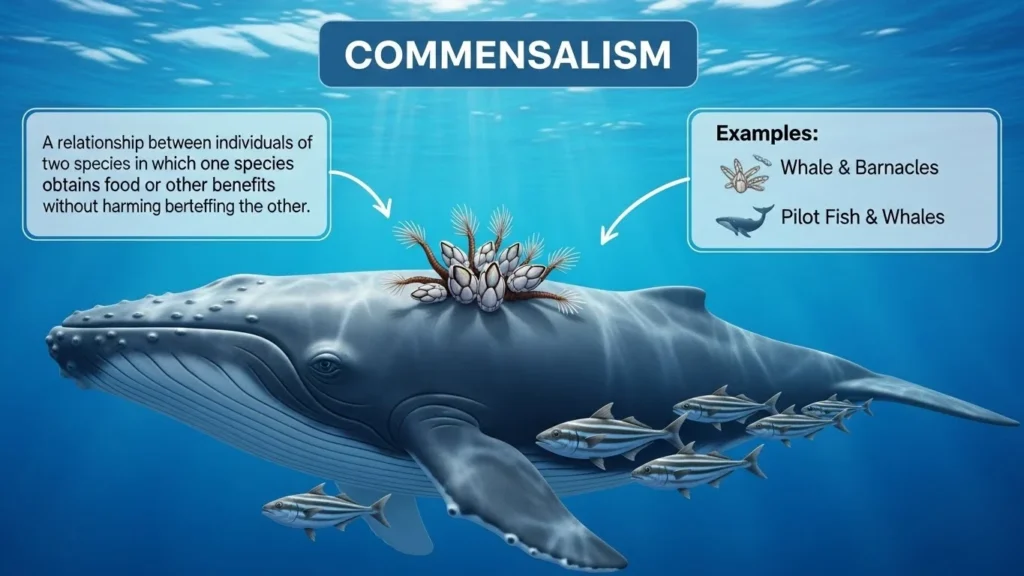
Barnacles attaching to whales for transport (barnacles benefit, whale unaffected)
Remora fish hitching rides on sharks (remora benefits, shark unaffected)
Orchids growing on trees (orchid benefits, tree unaffected)
These examples help explain how species coexist without negatively impacting each other.
Commensalism Meaning in Biology
Commensalism meaning in biology refers to a type of symbiotic relationship where one organism benefits while the other experiences no significant effect. It is one of the main types of ecological interactions, alongside mutualism and parasitism, and plays an important role in maintaining ecosystem balance.
Mutualism
Mutualism is a type of symbiotic relationship where both organisms benefit from the interaction. For example, bees and flowers share a mutualistic relationship—bees get nectar for food, while flowers are pollinated. Mutualism promotes cooperation and interdependence in ecosystems.
Commensalism Meaning and Example
Commensalism meaning and example describes a relationship where one species gains benefits such as food, shelter, or transportation, while the other remains unaffected. For instance, cattle egrets follow grazing animals to feed on insects stirred up by their movement, benefiting the birds without affecting the animals.
Commensalism Meaning in Humans
Commensalism meaning in humans refers to interactions where one organism benefits from living on or inside the human body without causing harm. For example, certain bacteria on human skin feed on dead cells without affecting the host. These relationships are generally harmless and can sometimes even provide indirect benefits.
Commensalism Meaning in Microbiology
Commensalism meaning in microbiology involves microorganisms that live in or on a host without causing harm. Many microbes in the human gut or skin are commensal, meaning they benefit from nutrients and a stable environment while not affecting the host negatively.
Parasitism
Parasitism is a type of symbiotic relationship where one organism (the parasite) benefits at the expense of another (the host). For example, ticks feeding on animals or parasites living inside the human body. Unlike commensalism, parasitism harms the host.
Amensalism
Amensalism is a relationship where one organism is harmed while the other is unaffected. For example, certain plants release chemicals that inhibit the growth of nearby plants. The plant releasing the chemicals is unaffected, while others are negatively impacted.
What Does “Commensalism” Mean?
In biology, commensalism is a relationship between two living organisms where:
One organism benefits
The other is neither helped nor harmed
In simple terms: one side gets something useful, and the other doesn’t notice at all. No damage, no reward—just neutral.
The Simple Definition
Think of it this way: one benefits, the other doesn’t care. That’s commensalism in a nutshell.
Where the Word Comes From
“Commensalism” comes from Latin:
com = together
mensa = table
So literally, it means “eating at the same table.” Imagine one organism getting food while the other isn’t affected—that’s exactly the original idea.
Is Commensalism Always Biological?
Traditionally, yes—it’s a biology and ecology term. But nowadays, people also use it metaphorically to describe one-sided benefits in human interactions, social media, or business relationships.
For example, a small creator gaining exposure on a big platform without affecting the platform itself is often called commensalism in modern chat.
How Commensalism Is Used in Real Life
Once you know what to look for, you’ll see commensalism everywhere.
1. In Nature and Biology
This is the classic usage:
Birds nesting in trees
Fish attaching to larger sea animals
Bacteria living harmlessly in the human body
Here, one organism gets shelter, food, or protection, and the other continues life as normal.
2. In Education and Science Discussions
You’ll often hear commensalism compared to:
Mutualism (both benefit)
Parasitism (one benefits, one is harmed)
Learning commensalism helps students understand how ecosystems stay balanced.
3. In Modern Conversations (Metaphorical Use)
Online, people might use commensalism to describe:
A content creator benefiting from a platform’s free tools
A startup taking advantage of an ecosystem without affecting others
Any one-sided advantage that doesn’t cause harm
Example:
“Their relationship is basically commensalism—one side gains visibility, the other isn’t impacted.”
Real-Life Commensalism Examples (Explained Simply)
Here are some easy-to-grasp examples of commensalism meaning and example:
Example 1: Birds and Trees
Birds build nests in trees
Birds get shelter, trees aren’t affected
Why it’s commensalism: The bird benefits, the tree doesn’t notice
Example 2: Remora Fish and Sharks
Remora fish attach to sharks
Eat leftovers from shark meals
Why it’s commensalism: Free food for the fish, neutral impact on the shark
Example 3: Humans and Certain Bacteria
Some bacteria live on your skin
Bacteria get a home
You’re unaffected
Why it’s commensalism: Bacteria benefit without harming you
Example 4: Metaphorical Use Online
Creator uses a platform’s free tools
Creator benefits
Platform isn’t impacted
Why it’s commensalism: One gains value, the other stays neutral
Common Mistakes and Misunderstandings
Many people confuse commensalism with other relationships. Here’s how to avoid that:
Confusing commensalism with mutualism
Commensalism: One benefits, the other is unaffected
Mutualism: Both benefit
Confusing it with parasitism
Parasitism: One benefits, the other is harmed
Assuming “unaffected” means “barely affected”
Neutral truly means neutral. Any benefit or harm disqualifies it as commensalism.
Thinking commensalism is rare
It’s actually very common in nature; it just gets less attention than dramatic parasitic relationships.
Commensalism vs Similar Terms (Quick Comparison)
Understanding related terms helps make commensalism clearer:
Mutualism: Both organisms benefit (Bees and flowers)
Parasitism: One benefits, the other is harmed (Ticks on mammals)
Amensalism: One is harmed, the other is unaffected (Certain plants blocking others with chemicals)
Symbiosis: General term for close species relationships (includes commensalism, mutualism, and parasitism)
Key takeaway: Commensalism is a type of symbiosis, but not all symbiotic relationships are commensalism.
Why Commensalism Still Matters Today
You might wonder why this term matters outside biology class:
Explains ecosystems: Not all interactions are competitive or harmful; commensalism shows balance exists naturally.
Useful in social/business metaphors: Describes one-sided benefits online, in creator economies, or in collaborations.
Improves scientific literacy: Helps interpret science news, climate discussions, and environmental issues more accurately.
How to Use “Commensalism” Correctly in a Sentence
Here’s the natural way to use it:
“The relationship between the two species is an example of commensalism.”
“Some bacteria live in commensalism with humans.”
“The author used commensalism as a metaphor for one-sided benefit.”
Avoid using it when:
Both sides benefit
Harm is involved
The relationship isn’t neutral for one party
Related Terms You Might See Online
Symbiosis: Close biological relationship
Mutualism: Both benefit
Parasitism: One benefits, one is harmed
Ecological relationships: Interactions between organisms
Host organism: The unaffected organism in commensalism
