
FPGA Board
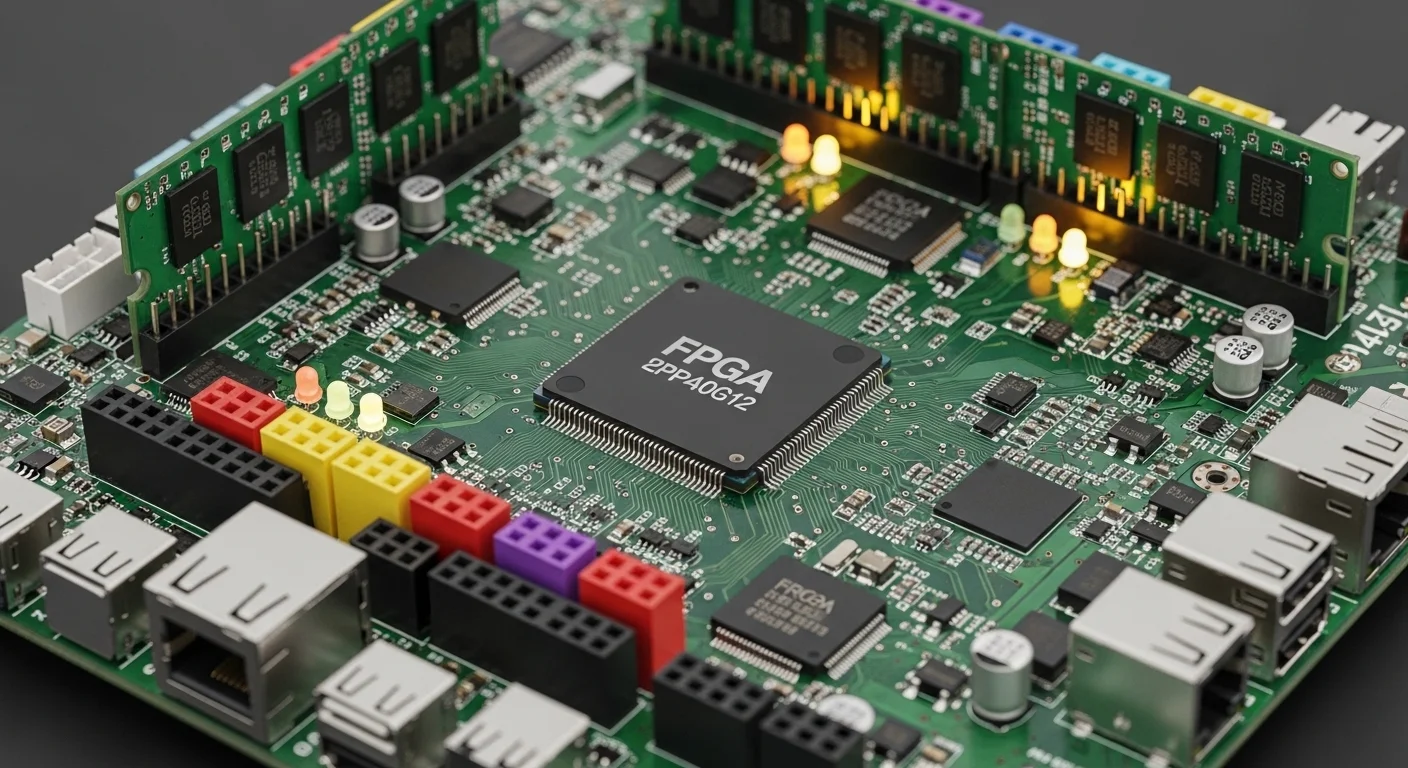
FPGA Board refers to a development board featuring a Field-Programmable Gate Array (FPGA) chip, used for prototyping, testing, and implementing digital circuits in engineering, electronics, and embedded systems projects.
FPGA Programming
FPGA programming involves writing hardware description language (HDL) code, like VHDL or Verilog, to configure the logic blocks and interconnections of an FPGA to perform specific tasks or digital functions.
FPGA Meaning Engineering
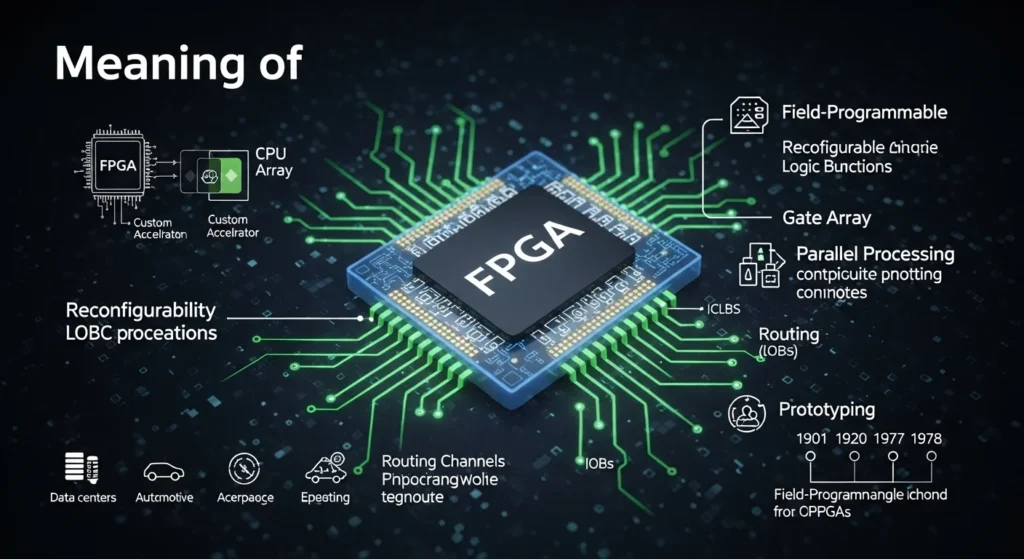
FPGA meaning in engineering: FPGA stands for Field-Programmable Gate Array, a reconfigurable integrated circuit used for designing custom digital logic circuits efficiently and flexibly.
FPGA Meaning Finance
FPGA meaning in finance: In certain financial contexts, FPGA may refer to specialized programmable hardware used for high-frequency trading systems and low-latency data processing.
FPGA Architecture
FPGA architecture consists of an array of programmable logic blocks, interconnects, input/output blocks, and sometimes embedded processors, allowing designers to implement custom digital circuits.
FPGA Examples
FPGA examples include digital signal processing, robotics control, network routers, cryptocurrency mining hardware, image processing, and prototyping custom CPUs or accelerators.
FPGA vs Microcontroller
FPGA vs microcontroller: Unlike microcontrollers, which have fixed architectures and execute sequential code, FPGAs are highly parallel and reconfigurable, allowing designers to implement hardware-level customization and faster processing for specific applications.
FPGA Meaning Quant
FPGA meaning in quant finance: FPGAs are often deployed in quantitative trading for ultra-low-latency data processing, algorithmic trading, and accelerating complex financial computations.
What Does “FPGA” Mean in Chat or Text?
FPGA stands for Field-Programmable Gate Array.
In simple terms:
An FPGA is a type of computer chip that you can reprogram after it’s made.
Unlike normal processors (CPUs) or graphics cards (GPUs), which have fixed behavior, an FPGA can be rewired through software to do very specific tasks extremely fast.
FPGA Meaning in Plain English
Think of it like this:
A CPU is like a Swiss Army knife — flexible, but not the fastest at one task
A GPU is like a graphics powerhouse — great for parallel work
An FPGA is like LEGO bricks — you build exactly what you need, when you need it
That’s why people often talk about FPGA in contexts like:
High-performance computing
AI acceleration
Crypto mining (older setups)
Networking equipment
Embedded systems
Game emulation
Does FPGA Have Different Meanings?
Not really. Unlike many chat abbreviations, FPGA almost always means Field-Programmable Gate Array. However, the way people use it changes depending on context:
Casual chat: “This runs way better on FPGA.”
Tech forums: “FPGA vs ASIC performance comparison.”
Work chat: “We’re prototyping this on an FPGA first.”
Quick Note on Origins
FPGA is not internet slang in the traditional sense. It originated in hardware engineering in the 1980s and later spread into online communities as tech culture became more mainstream. Today, it’s common to see FPGA mentioned casually in chats where people talk about performance, speed, or custom hardware.
How People Use “FPGA” in Real Conversations
FPGA used to be a niche term. In 2026, it’s part of everyday tech talk — even outside hardcore engineering spaces.
Where You’ll See FPGA Mentioned
People casually use FPGA on:
Text messages between tech friends
Discord servers (gaming, emulation, dev communities)
Reddit (especially r/hardware, r/FPGA, r/emulation)
Twitter/X tech threads
YouTube comments under tech videos
Slack or Teams at work
Typical Ways People Use FPGA in Chat
Here’s how it shows up naturally:
As a flex: implying high technical skill
As a comparison: FPGA vs CPU vs GPU
As a solution: when performance or latency matters
As a learning step: before building a final chip
When It Sounds Natural vs Awkward
Sounds natural when:
Talking about performance, speed, or efficiency
Discussing hardware projects
Comparing computing solutions
Sounds awkward when:
Dropped randomly in non-tech chats
Used as a buzzword without context
Confused with software-only tools
If someone says “Just use an FPGA” without explanation, that’s usually a sign they’re deep in tech mode.
Real-Life Examples of “FPGA” in Text Messages
Here’s how FPGA appears in real conversations — and what each example actually means.
Example 1
“The latency is way lower on FPGA than GPU.”
Meaning:
They’re saying the FPGA responds faster because it’s custom-built for the task.
Example 2
“This emulator runs on FPGA, so it’s basically hardware-accurate.”
Meaning:
FPGA is being used to recreate original hardware behavior very precisely (common in retro gaming).
Example 3
“We’ll prototype it on FPGA before making an ASIC.”
Meaning:
They’re testing the design using a flexible chip before manufacturing a permanent one.
Example 4
“FPGA dev is hard but worth it.”
Meaning:
Programming hardware directly is challenging, but powerful.
Example 5
“Nah, that project doesn’t need FPGA — CPU is enough.”
Meaning:
FPGA would be overkill for a simple task.
Common Mistakes & Misunderstandings
Even though FPGA is a technical term, it’s often misunderstood in chat and online discussions.
1. Thinking FPGA Is Software
This is the most common mistake.
FPGA is hardware, not an app, framework, or programming language. You program it, but it remains a physical chip.
2. Confusing FPGA With ASIC
People often mix these up.
FPGA: Reprogrammable, flexible, slower than ASIC
ASIC: Fixed, extremely fast, not changeable after manufacturing
3. Assuming FPGA Is Only for Experts
While FPGA development is advanced, modern tools and communities have made learning it more accessible than ever.
4. Treating FPGA Like Internet Slang
Unlike abbreviations such as LOL or BRB, FPGA is not casual slang. It’s a technical acronym that happens to be used casually by tech-savvy people.
Related Slangs & Abbreviations
If you’re seeing FPGA, you’ll probably run into these terms too:
CPU (Central Processing Unit) – General-purpose processor
GPU (Graphics Processing Unit) – Parallel computing powerhouse
ASIC (Application-Specific Integrated Circuit) – Fixed-function chip
SoC (System on a Chip) – All-in-one processor system
RTL (Register Transfer Level) – Hardware design abstraction
HDL (Hardware Description Language) – Languages like Verilog or VHDL
Why FPGA Matters More in 2026
FPGA isn’t just an old engineering term anymore. It’s becoming more visible because:
AI workloads need custom acceleration
Low-latency systems are more valuable
Edge computing is growing fast
Retro gaming and hardware emulation are booming
Cloud providers now offer FPGA instances
So when someone mentions FPGA in chat today, they’re usually talking about performance, control, or precision.