
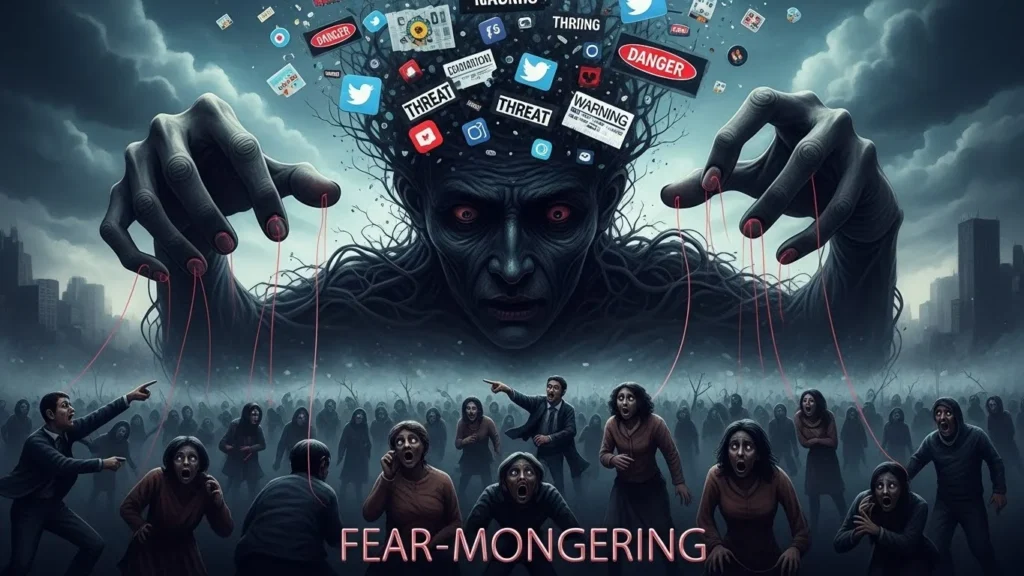
Fear Mongering Meaning in Hindi
The fear mongering meaning in Hindi is “भय फैलाना” (bhay phailana), which refers to creating unnecessary fear or panic among people. It is often used in politics, media, or social situations where exaggeration or misinformation is used to influence public perception.
Fear mongering in Hindi conveys the act of manipulating emotions to provoke anxiety or panic, making people act out of fear rather than reason.

Fear Mongering Meaning in English
The fear mongering meaning in English is the deliberate use of fear to influence opinions, behavior, or decisions. It is often associated with spreading exaggerated threats, alarming statements, or false information to manipulate others.
This tactic is commonly used in media, politics, or advertising to control public perception, encourage compliance, or create unnecessary worry.
Fear Mongering Synonym
Some common fear mongering synonyms include:
- Scaremongering
- Alarmism
- Panic-mongering
- Intimidation tactics
These words describe similar actions where fear is used as a tool to influence behavior or decisions, often in exaggerated or misleading ways.
Fear Mongering in a Sentence
Here are examples of fear mongering in a sentence:
- “The politician’s speech was pure fear mongering to gain votes.”
- “Media fear mongering can lead to unnecessary panic in society.”
- “Fear mongering tactics often backfire when people realize the exaggeration.”
These examples show how the term is used to describe deliberate attempts to provoke fear.
Fear-Mongering Psychology
Fear-mongering psychology studies how fear can be used to manipulate behavior. Human brains respond strongly to perceived threats, making fear an effective tool for influencing decisions.
Psychologists note that fear mongering can lead to anxiety, stress, and poor decision-making. Understanding these psychological effects helps people recognize manipulation and respond rationally rather than emotionally.
Fear Mongering Pronunciation
Fear mongering pronunciation is: /fɪr ˈmʌn.dʒər.ɪŋ/.
Breaking it down:
- Fear → rhymes with “here”
- Mon → sounds like “mun”
- Gering → “jer-ing”
Correct pronunciation ensures clear communication, especially in discussions about media, politics, or social behavior.
Fear Mongering or Scaremongering
Fear mongering or scaremongering are essentially synonymous. Both terms describe the act of spreading fear deliberately to influence or control others.
While “fear mongering” is more common in American English, “scaremongering” is often used in British English. Both convey the same idea of exaggerated or manipulative fear tactics.
Fear Mongering Meaning in Spanish
The fear mongering meaning in Spanish is “alarmismo” or “propagación del miedo”, referring to creating unnecessary fear or panic to influence behavior or opinions.
It is used similarly to English, particularly in media, politics, and public discourse, to describe manipulative or alarming behavior intended to provoke anxiety.
What Does “Fear Mongering” Mean in Chat or Text?
Fear mongering refers to the act of deliberately spreading fear, panic, or anxiety, usually to influence opinions or behavior. Unlike casual warnings or advice, fear mongering often exaggerates risks or presents threats as inevitable.
Key points about fear mongering:
Definition: Deliberately spreading fear to influence others.
Purpose: Often to control, manipulate, or provoke strong emotional reactions.
Common contexts: Politics, media headlines, social media discussions, and group chats where rumors spread quickly.
Origin & History:
The term comes from the word “monger,” meaning a dealer or trader. Originally, it referred to someone who “traded” in something undesirable, like a “fishmonger.” Over time, fear mongering became the term for someone “trading in fear”—basically profiting from making others scared. In online chat culture, it’s used to call out people who exaggerate or dramatize situations to make others anxious or panicked.
Different Meanings Based on Context:
Casual chat: Can describe friends joking about something scary or dramatic.
Social media: Often points to posts that exaggerate events to gain attention or clicks.
Gaming/Discord: Sometimes used humorously when someone warns teammates of unlikely threats in a tense game moment.
How People Use “Fear Mongering” in Real Conversations
Fear mongering has found its way into everyday chats, online forums, and social media posts. Here’s how people use it:
Platforms:
Texting & WhatsApp: “Stop fear mongering! It’s probably just a glitch.”
Instagram & Twitter/X: Users call out clickbait or exaggerated posts as fear mongering.
Snapchat & Discord: Friends joking about exaggerated threats in games or rumors.
Forums & Reddit: Frequently used in discussions about politics, tech, or viral news.
When it’s appropriate vs awkward:
Appropriate: When someone is actually exaggerating danger or spreading panic.
Awkward: When overused or misapplied to minor warnings, it can make the accuser seem dismissive or rude.
Pro Tips:
If a post or chat message seems designed to scare rather than inform, it’s probably fear mongering.
Watch the tone: fear mongering often uses urgent language like “Everyone is in danger!” or “This will destroy everything!”
Real-Life Examples of “Fear Mongering” in Text Messages
Here are some realistic examples showing how fear mongering appears in digital conversations:
Text Example:
Friend 1: “Did you hear about the new app? It can steal all your data!”
Friend 2: “Whoa, stop fear mongering. It’s just an update notification.”
Social Media Example:
Tweet: “If you don’t buy this gadget now, you’ll regret it forever!”
Comment: “Classic fear mongering to sell more stuff.”
Gaming Example:
Gamer 1: “The boss is impossible! We’ll all fail!”
Gamer 2: “Chill, don’t fear monger. We can do this together.”
Political Chat Example:
Post: “If they win, the economy will collapse overnight!”
Response: “That’s straight-up fear mongering.”
Explanation:
Each example shows exaggerated danger or consequences. Fear mongering thrives on emotion—mainly fear—rather than facts or calm advice.
Common Mistakes & Misunderstandings
Even if you know the term, it’s easy to misuse it. Here are common pitfalls:
Confusing with warnings: Not every alert or caution is fear mongering. For example, reminding someone to lock their doors isn’t fear mongering—it’s practical advice.
Misreading tone: Text messages lack voice cues, so humor or sarcasm can be mistaken for fear mongering.
Overusing the term: Calling everything fear mongering can make you seem dismissive or cynical.
Related Slangs & Abbreviations
Understanding fear mongering also helps you recognize related online terms:
FUD (Fear, Uncertainty, Doubt): Common in tech and finance, similar to fear mongering.
Clickbait: Headlines or posts designed to provoke fear or curiosity to get clicks.
Drama llama: Someone exaggerating situations or stirring up panic in group chats.
Gaslighting: Manipulating someone’s perception, sometimes overlaps with fear mongering.
