
Implications Synonym
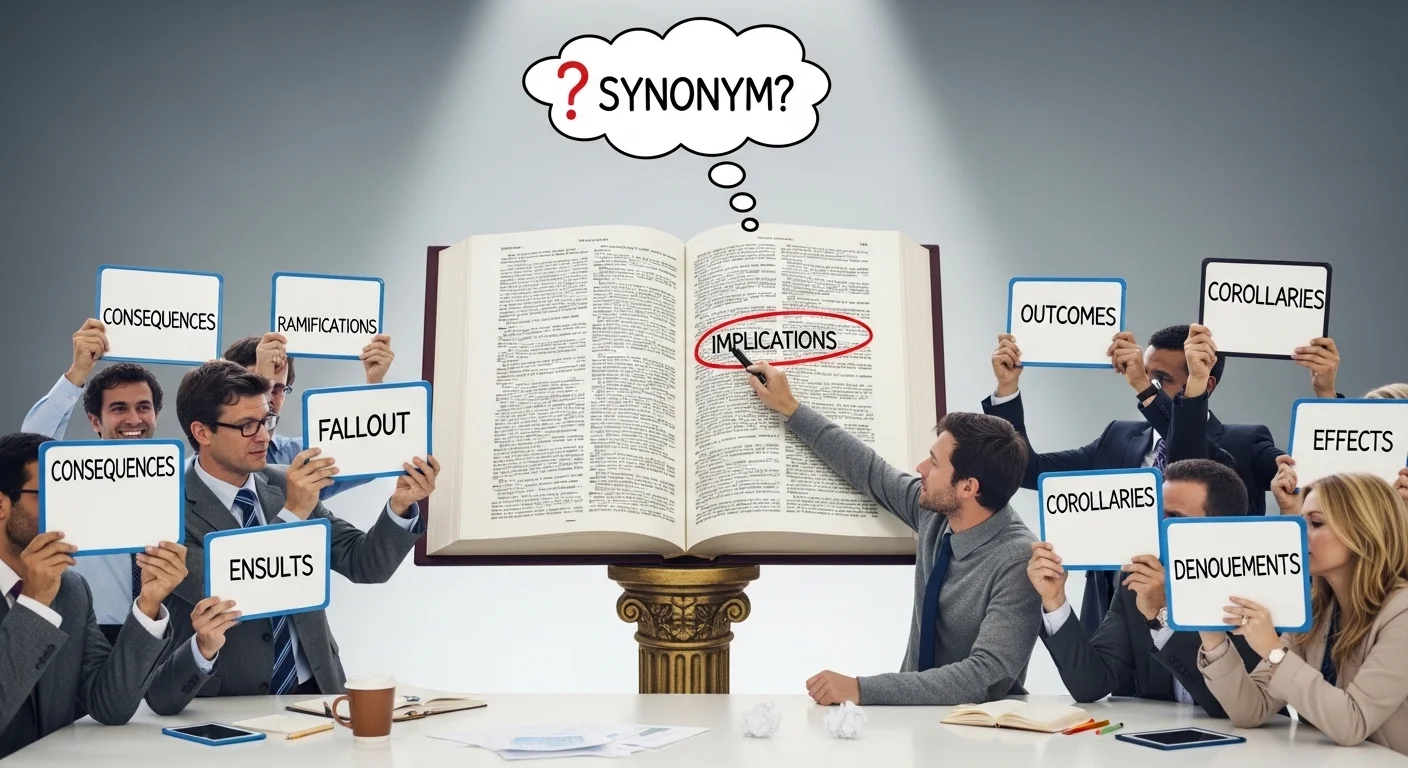
The word “implications” is often used to describe the possible effects, meanings, or consequences of something. When looking for synonyms, several words can express a similar idea depending on the context. Common alternatives include “consequences,” “effects,” “outcomes,” “results,” and “ramifications.” In more subtle situations, words like “suggestions,” “inferences,” or “indications” may be more appropriate, especially when referring to implied meaning rather than direct results.
For example, if a decision has serious implications, you could also say it has serious consequences or outcomes. On the other hand, if someone’s words have hidden implications, you might describe them as carrying indirect suggestions or meanings. Choosing the right synonym depends on whether you’re focusing on results or implied ideas, but all convey the sense that something leads to or hints at something else.
Educational Implication Meaning
Educational implication refers to how a theory, research finding, or idea can be applied in a learning or teaching environment. It explains what the results mean for teachers, students, schools, or educational systems and how those insights can improve learning outcomes.
For instance, if a study shows that students learn better through interactive activities, the educational implication would be that teachers should use more hands-on or group-based methods in the classroom. This concept is widely used in academic discussions to connect theory with real-world teaching practices. In simple terms, educational implication answers the question: “How can this help improve education?”
Implication Meaning in Research
In research, implication refers to the importance or impact of the study’s findings. It explains how the results can be used, what they suggest for future studies, and how they might influence real-world decisions or practices.
Researchers often include implications in the conclusion or discussion section of their work. For example, if a study finds a link between exercise and better mental health, the implication might be that healthcare providers should encourage physical activity as part of treatment plans. Research implications help readers understand why the study matters and how its findings can be applied beyond the research itself.
Implication Meaning for Kids
For kids, implication can be explained in a very simple way as “something that might happen because of an action” or “a hidden meaning behind something someone says.” It’s about understanding what comes next or what is being suggested without being directly said.
For example, if a child forgets to do homework, the implication might be getting a lower grade or facing consequences at school. Similarly, if someone says, “It’s getting late,” the implication could be that it’s time to go home. Teaching implication to kids helps them understand cause and effect as well as how to read between the lines in everyday conversations.
Implication Meaning in Chinese
In Chinese, the concept of implication is often expressed using words like “含义” (hán yì), which means meaning or implied meaning, and “影响” (yǐng xiǎng), which refers to influence or effect. The exact translation depends on the context in which the word “implication” is used.
For example, if you’re talking about hidden meaning, “含义” would be more suitable. If you’re referring to consequences or effects, “影响” fits better. In everyday language, implication in Chinese still carries the idea of something not directly stated or the result of an action. Understanding these variations helps learners use the term correctly in different situations.
Implication Meaning in Math
In mathematics, implication refers to a logical relationship between two statements where one statement leads to another. It is often written in the form “if… then…” and shows that when the first statement is true, the second statement must also be true.
For example, in the statement “If a number is even, then it is divisible by 2,” the first part implies the second. This type of reasoning is essential in solving problems and proving mathematical ideas. Mathematical implication helps build clear connections between concepts and ensures logical consistency in calculations and proofs.
Implication Meaning in Discrete Mathematics
In discrete mathematics, implication is a fundamental concept in logic that describes a conditional relationship between two propositions. It is usually written as “p → q,” meaning “if p is true, then q is also true.” This type of statement is called a conditional or logical implication.
Understanding implication is crucial in topics like algorithms, proofs, and computer science. For example, if “p” represents “a number is divisible by 4,” and “q” represents “the number is even,” then “p → q” is true because every number divisible by 4 is also even. Discrete mathematics relies heavily on such logical structures to analyze and solve problems accurately.
Policy Implication Meaning
Policy implication refers to how research findings, data, or ideas can influence decisions made by governments, organizations, or institutions. It highlights what actions should be taken or what changes might be needed based on certain evidence or outcomes.
For example, if research shows that air pollution is causing health issues, the policy implication could be that stricter environmental regulations should be introduced. This concept is commonly used in public policy, economics, and social sciences to connect research with real-world decision-making. In simple terms, policy implication explains how information can guide better policies and improve society.
What Does “Implication” Mean in Chat or Text?
Implication means something that is suggested or hinted at, rather than said directly.
In chat or text messages, implication happens when:
The words themselves are neutral or vague
But the real meaning is hidden between the lines
Simple definition:
Implication = what someone means without directly saying it
Implication Meaning in Slang and Online Communication
In modern chat culture, implication is extremely common because:
People avoid being too blunt
Tone can be risky in text
Sarcasm and subtle hints are popular
Screenshots last forever
For example:
“I guess you’re busy.”
The implication is not about being busy.
It usually implies disappointment, annoyance, or feeling ignored.
Brief Origin of the Term “Implication”
The word implication comes from Latin implicare, meaning to entwine or involve. Over time, it came to mean:
Something contained within
A meaning that isn’t stated openly
Long before texting existed, implication was used in:
Literature
Politics
Social etiquette
Today, it’s a core part of internet slang, texting culture, and social media communication.
How People Use “Implication” in Real Conversations
Implication shows up everywhere online—sometimes intentionally, sometimes accidentally.
Common Platforms Where Implication Is Used
You’ll see implication constantly on:
Text messages (SMS, WhatsApp)
Instagram DMs
Snapchat
Discord servers
Dating apps
Reddit and forums
Gaming chat
Why People Prefer Implication Instead of Saying Things Directly
From real-world usage, people imply things because:
It feels safer emotionally
It avoids confrontation
It leaves room for deniability
It sounds more casual or polite
For example:
Saying “That’s one way to do it”
often implies disapprovalSaying “Interesting choice”
may imply judgment or sarcasm
When Implication Is Appropriate vs Awkward
Appropriate situations:
Light sarcasm with friends
Flirting
Soft criticism
Humor
Awkward or risky situations:
Professional chats
Sensitive topics
Arguments
Talking to non-native speakers
In text, implication can easily be misread, especially without emojis or voice tone.
Real-Life Examples of “Implication” in Text Messages
Below are realistic chat examples showing implication in action, plus what they really mean.
Example 1
Text:
“Wow, must be nice.”
Implication:
The person is likely jealous, annoyed, or feeling left out, not genuinely impressed.
Example 2
Text:
“Do whatever you want.”
Implication:
This usually means they’re upset and do not actually agree.
Example 3
Text:
“Oh, you remembered.”
Implication:
They’re implying you usually forget or that they expected better.
Example 4
Text:
“I’m not saying anything, but…”
Implication:
They absolutely are saying something—just indirectly.
Example 5
Text:
“That reply took a while.”
Implication:
They feel ignored or unimportant.
These examples show why understanding implication meaning in text is crucial in modern communication.
Common Mistakes & Misunderstandings About Implication
Even fluent English speakers mess this up online.
1. Taking Everything Literally
One of the biggest mistakes is assuming:
Words mean exactly what they say
There’s no hidden meaning
In chat culture, that’s rarely true.
2. Missing Cultural or Social Context
Implication depends heavily on:
Relationship
Mood
Past conversations
Social norms
A phrase from a close friend can feel playful, while the same phrase from a coworker feels passive-aggressive.
3. Over-Reading Implication Where None Exists
Not every short or dry message has a hidden meaning. Sometimes:
People are tired
Multitasking
Not emotionally invested
Overanalyzing implication can cause unnecessary drama.
4. Confusing Implication With Sarcasm
They often overlap, but they’re not the same.
Implication: Hidden meaning
Sarcasm: Saying the opposite of what you mean (often humorously)
5. Assuming Everyone Uses Implication the Same Way
Different generations use implication differently:
Gen Z tends to imply more subtly
Millennials balance direct and indirect
Some cultures value very direct communication
Related Slangs & Abbreviations Connected to Implication
If you’re learning implication, these related chat terms often appear alongside it.
Passive-Aggressive
Indirect expression of negative feelings through implication.
Subtweet
Posting about someone without naming them—pure implication.
Read Between the Lines
A phrase that literally means understand the implication.
“I’m Just Saying”
Often implies criticism without owning it.
Dry Texting
Short replies that may imply disinterest—or nothing at all.
Why Understanding Implication Matters More Than Ever
In 2026, most communication happens:
Without tone of voice
Without facial expressions
In fast, informal messages
That makes implication:
Easier to use
Easier to misunderstand
Knowing how implication works helps you:
Avoid arguments
Understand flirting
Read social cues
Communicate more clearly online
