

Central Idea Meaning in English
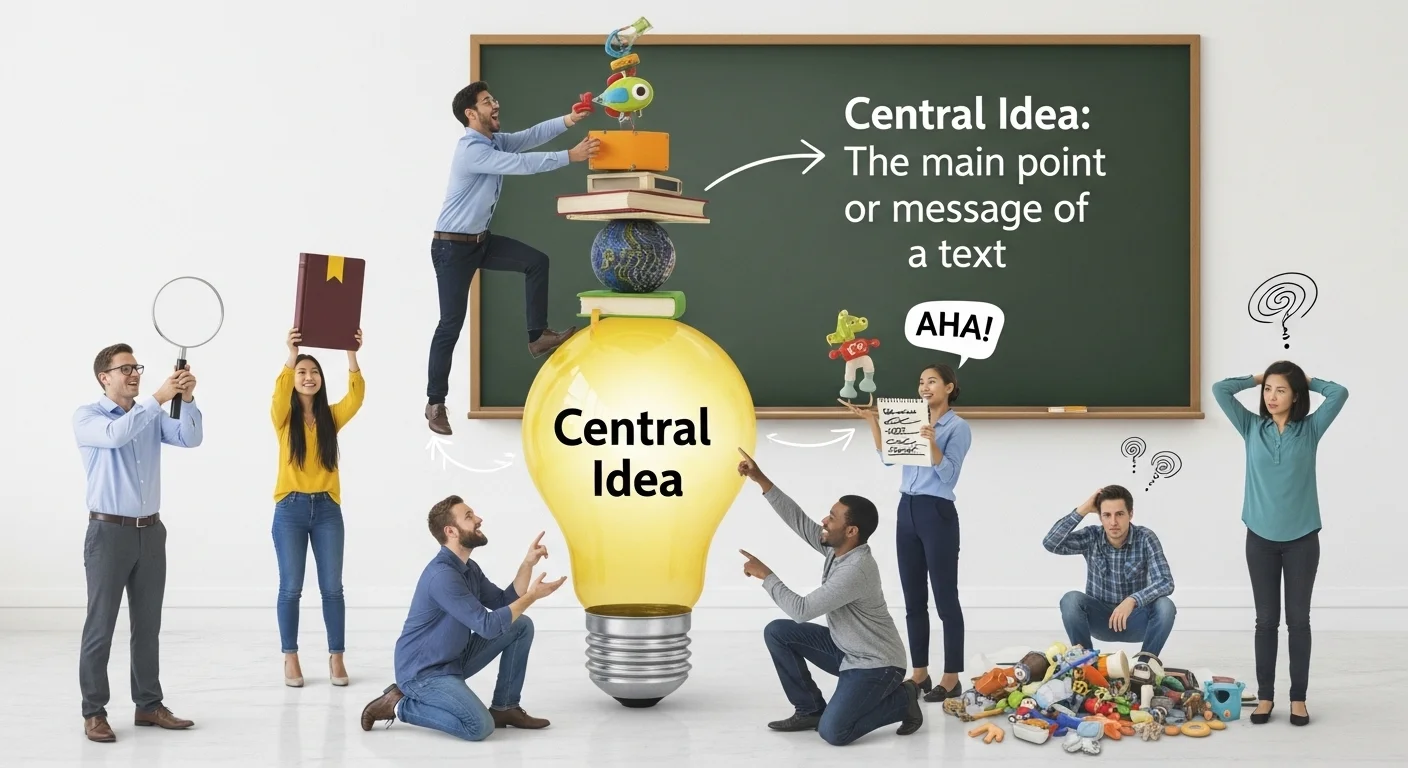
The central idea meaning in English refers to the main point or key message that a piece of writing is trying to express. It answers the question, “What is this text mostly about?”
For example, in a short paragraph about healthy eating, the central idea might be that eating balanced meals improves overall health. All the supporting sentences would relate back to this main point. Understanding the central idea makes reading easier because it helps you focus on what truly matters in the text.
Central Idea Meaning in Literature
The central idea meaning in literature goes a bit deeper, as it reflects the underlying message or insight that a writer wants to share through a story, poem, or novel. It is often revealed through characters, events, and conflicts.
For instance, a story about friendship might have a central idea about loyalty and trust. Unlike simple texts, literature may not state the central idea directly, so readers often need to think critically to identify it. This makes it an important skill for deeper understanding and analysis.
Central Idea Examples
Looking at central idea examples can make the concept much clearer. In a passage about climate change, the central idea might be that human activities are affecting the environment. In a story about hard work, the central idea could be that persistence leads to success.
Each example shows how all the details in the text support one main point. By identifying these examples, readers can better understand how writers organize their thoughts and communicate their message effectively.
Central Idea Definition Examples
Central idea definition examples help connect the concept with real usage. The central idea can be defined as the most important point or message in a text, supported by details and explanations.
For example, in a paragraph about the importance of education, the central idea might be that education opens opportunities for a better future. The supporting sentences would include reasons, facts, or examples that reinforce this idea. These examples show how the definition works in practice.
Central Idea Synonym
A central idea synonym includes terms that carry a similar meaning, such as “main point,” “core message,” “key idea,” or “primary concept.” These words are often used interchangeably depending on the context.
While the wording may change, the meaning remains the same—focusing on the most important part of a text. Using synonyms can help make your writing more varied and easier to understand without repeating the same phrase.
Main Idea and Central Idea Meaning
The main idea and central idea meaning are closely related and often used interchangeably. Both refer to the most important point in a piece of writing.
However, “main idea” is more commonly used in basic reading and shorter texts, while “central idea” is often used in more detailed analysis, especially in literature. Despite this slight difference, both terms guide readers toward understanding the core message of the text.
Central Idea vs Main Idea
When comparing central idea vs main idea, the difference is mostly about usage rather than meaning. Both terms describe the key point of a text, but they are used in slightly different contexts.
“Main idea” is often used in everyday reading and education, especially for shorter passages. “Central idea,” on the other hand, is more common in literary analysis and formal writing. In most cases, they can be used interchangeably without changing the meaning.
Central Idea vs Theme
The comparison of central idea vs theme highlights an important distinction. The central idea is the main point of the text, while the theme is the deeper message or lesson behind it.
For example, in a story about overcoming challenges, the central idea might describe the events of struggle and success, while the theme could be about resilience or perseverance. Understanding this difference helps readers analyze texts more effectively and appreciate deeper meanings.
What Does “Central Idea” Mean in Text or Reading?
The central idea meaning refers to the primary point or message that a text or passage communicates. Think of it as the “heart” of the story, article, or essay. Everything in the text usually supports or relates to this main idea.
Key points to remember:
It’s not the same as the topic. The topic is the subject (like “climate change”), while the central idea is the author’s main message about that topic (like “We must act now to reduce climate change”).
It’s usually expressed in one clear sentence but can sometimes be implied.
In stories, it’s what the author wants the reader to take away after reading.
Origins & context:
The concept of the central idea comes from classic literary analysis and has been a part of reading comprehension strategies for decades. It’s especially emphasized in schools and standardized tests, but it’s also useful in everyday reading, such as blogs, social media posts, and news articles.
How People Use “Central Idea” in Real Conversations
While “central idea” is mostly an academic term, it shows up in modern discussions, especially in online forums, study groups, and educational chats.
Platforms where it’s commonly used:
Texting: Students often ask, “What’s the central idea of this article?”
Discord & forums: Book clubs or study channels use it for discussion.
Social media & blogs: Writers often summarize posts or threads with the central idea.
Classrooms & study apps: Teachers and peers discuss it to improve comprehension.
When it’s appropriate vs. awkward:
Appropriate: “I think the central idea of this essay is about teamwork.”
Awkward: Using it in casual memes or non-educational chats (“This meme’s central idea is hilarious”)—people may understand, but it feels too formal.
Tip: Using “central idea” casually is fine when summarizing anything meaningful or structured, like a story, article, or video.
Real-Life Examples of “Central Idea” in Text Messages
Seeing examples makes understanding the central idea meaning much easier. Here are some realistic scenarios:
Example 1 – School Chat:
Student A: “I didn’t get the reading assignment.”
Student B: “The central idea is that pollution affects animals more than we think.”
Explanation: B summarizes the main message in one sentence.
Example 2 – Online Forum:
User1: “Can someone explain this article?”
User2: “Sure! The central idea is that AI can improve healthcare if used responsibly.”
Explanation: Highlights the core message without extra details.
Example 3 – Study Group Text:
Student: “The story had so many details!”
Friend: “Focus on the central idea: friendship helps people overcome challenges.”
Explanation: Emphasizes the main takeaway from a complex text.
Example 4 – Blog Discussion:
Commenter: “I loved this post.”
Writer reply: “Thanks! The central idea is that small habits create big changes over time.”
Explanation: Shows practical use of the term outside textbooks.
Common Mistakes & Misunderstandings
Even when people understand what a central idea is, mistakes happen.
Confusing topic with central idea
Topic = subject (“space exploration”)
Central idea = message about the topic (“Space exploration helps humanity learn more about our future”)
Using too many details
Central ideas should be concise, not a list of facts.
Missing implied messages
Sometimes authors never explicitly state the central idea. You have to infer it from supporting details.
Applying it in the wrong context
Don’t use “central idea” for casual jokes or irrelevant topics—it’s mainly for structured information.
Related Slangs & Abbreviations
In online discussions about reading or studying, you might encounter related terms:
Theme: The underlying message or moral (similar but broader than central idea).
Main idea: Often used interchangeably with central idea.
Summary: A brief description of the entire text, which usually includes the central idea.
Takeaway: Modern, casual term for the main lesson or idea from something you read or watched.
