
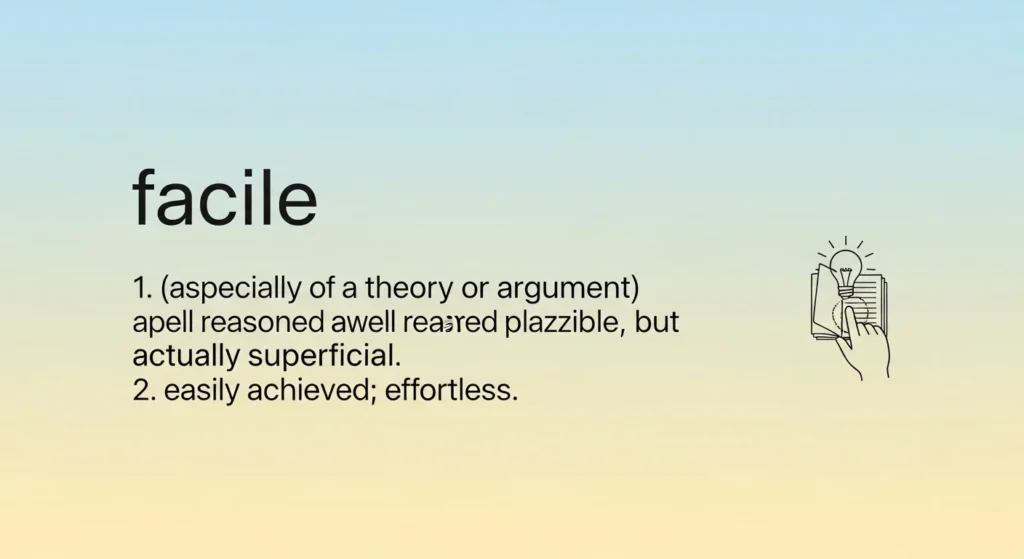
Facile meaning can be both fascinating and frustrating, depending on context. This word may seem simple at first, but it often hides a subtle critique — calling something too easy or shallow. Understanding its nuances will make your writing sharper and your conversations smarter.
Whether you’ve seen it in essays, online debates, or social media threads, knowing the facile meaning helps you spot ideas that are effortlessly clever yet might lack depth. By the end of this guide, you’ll confidently decode every use — from smooth compliments to sly criticisms.
What Does “Facile” Mean?
At its core, the facile meaning depends heavily on context.
Basic Definition
Facile generally means:
Too easy
Overly simple
Superficial or lacking depth
While it originally meant “easy to do,” modern usage often implies criticism, not praise.
Two Main Meanings of Facile
Literal / Neutral Meaning (Less Common Today)
Something done easily or effortlessly
Example: “She has a facile ability with languages.”
Critical / Negative Meaning (Most Common Today)
Something that is overly simplistic, glib, or not thoughtfully developed
Example: “That explanation is facile and ignores the real issue.”
Important: In most modern writing and speech, facile suggests a lack of depth, not skill.
The Origin and Evolution of “Facile”
Understanding the history helps explain why the word feels negative today.
Origin: Latin facilis → meaning “easy”
Entered English in the 15th century
Early meaning: easy to do or understand
Modern shift: too easy to the point of being shallow
Over time, writers and critics began using facile to dismiss arguments, opinions, or solutions that seem clever but don’t hold up under scrutiny.
This shift is why many people misinterpret the word.
How People Use “Facile” in Real Conversations
You’ll see facile most often in written English, but it does appear in speech — especially among educated speakers.
Common Places You’ll See “Facile”
Essays and academic writing
News articles and opinion pieces
Book and film reviews
Reddit debates and forums
Twitter/X commentary
Professional critiques
How It’s Commonly Used Today
In real-world usage, facile often means:
“That sounds smart, but it’s actually lazy”
“You’re simplifying something complex”
“This argument avoids nuance”
Appropriate vs Awkward Use
Appropriate:
Critiquing ideas, arguments, or explanations
Formal or semi-formal writing
Analytical discussions
Awkward or Risky:
Casual texting
Talking about people directly
Complimenting someone (unless you’re very careful)
Calling a person “facile” can sound insulting, even if you didn’t mean it that way.
Real-Life Examples of “Facile” in Use
Here are realistic examples you might encounter, along with clear explanations.
Example 1
“The article offers a facile explanation of a very complex problem.”
Meaning:
The explanation is too simple and ignores deeper issues.
Example 2
“Saying ‘just work harder’ is a facile response to burnout.”
Meaning:
The response is shallow and unhelpful.
Example 3
“His solution sounded clever but was ultimately facile.”
Meaning:
It seemed smart at first, but lacked real substance.
Example 4
“That movie relies on facile emotional tricks.”
Meaning:
The film uses cheap or obvious methods instead of meaningful storytelling.
Example 5
“She has a facile writing style.”
Meaning (ambiguous):
This could mean her writing is smooth and easy — or that it lacks depth. Context matters a lot here.
Common Mistakes and Misunderstandings
The facile meaning is often misunderstood, especially by non-native speakers.
Mistake 1: Assuming It’s Always a Compliment
Many people think facile means:
“talented”
“skilled”
“effortless”
In modern English, this is often wrong.
Mistake 2: Using It Like “Simple” or “Easy”
While related, facile carries judgment, not neutrality.
“Simple” → neutral
“Facile” → often dismissive or critical
Mistake 3: Applying It to People Casually
Calling someone “facile” can sound like:
You’re saying they’re shallow
You’re questioning their intelligence
That’s why it’s usually safer to apply it to ideas, arguments, or explanations, not people.
Mistake 4: Missing the Tone
Tone matters. In writing, facile almost always signals criticism — even if it’s subtle.
Facile Meaning in Writing vs Speaking
In Writing
More common
Often formal or academic
Strongly critical tone
In Speaking
Less common
Sounds intellectual or analytical
Can feel harsh if misused
If you’re unsure, consider using a clearer alternative.
Synonyms and Related Words
Here are related terms you’ll often see alongside facile, with subtle differences.
Similar Words
Simplistic – overly simple, lacking nuance
Shallow – lacking depth or seriousness
Glib – smooth but insincere
Superficial – surface-level understanding
Naive – innocent or inexperienced (not always critical)
Words People Confuse With “Facile”
Easy
Effortless
Fluent
These words do not automatically carry criticism, unlike facile.
Facile Meaning in Modern Online Culture (2026)
In 2026, facile is most often used in:
Online debates
Long-form posts
Thoughtful critiques
Comment sections where people call out oversimplification
It’s rarely used in:
Slang-heavy texting
Memes
Casual chat
This makes it a high-credibility word — but also one that should be used carefully.
When You Should (and Shouldn’t) Use “Facile”
Use It When:
Critiquing arguments or ideas
Writing analytically
Pointing out lack of depth
Avoid It When:
Giving casual compliments
Texting friends
You’re unsure of tone
If clarity matters more than sounding smart, consider alternatives like:
“Oversimplified”
“Too shallow”
“Misses the point”
FAQs About Facile Meaning
What does facile mean in simple words?
It usually means something is too simple in a way that lacks depth or serious thought.
Is “facile” a negative word?
Most of the time, yes. In modern usage, it often criticizes ideas or explanations as shallow.
Can facile ever be a compliment?
Rarely. In older or very specific contexts, it can mean “effortless,” but today it’s usually critical.
Is facile the same as simple?
No. “Simple” is neutral. “Facile” implies oversimplification or lack of insight.
Can I use facile to describe a person?
It’s risky. Describing someone as “facile” can sound insulting, even if unintended.
Key Takeaways: Facile Meaning Made Clear
Let’s simplify it one last time:
Facile meaning has shifted over time
Today, it usually implies oversimplified and shallow
It’s most often used to critique ideas, arguments, or explanations
Tone and context matter more than the dictionary definition
When in doubt, choose a clearer alternative
If you’ve ever paused mid-sentence wondering whether facile sounds smart or rude — now you know exactly how it lands.
What’s your favorite confusing word or chat term? Drop it in the comments and let’s break it down next.