
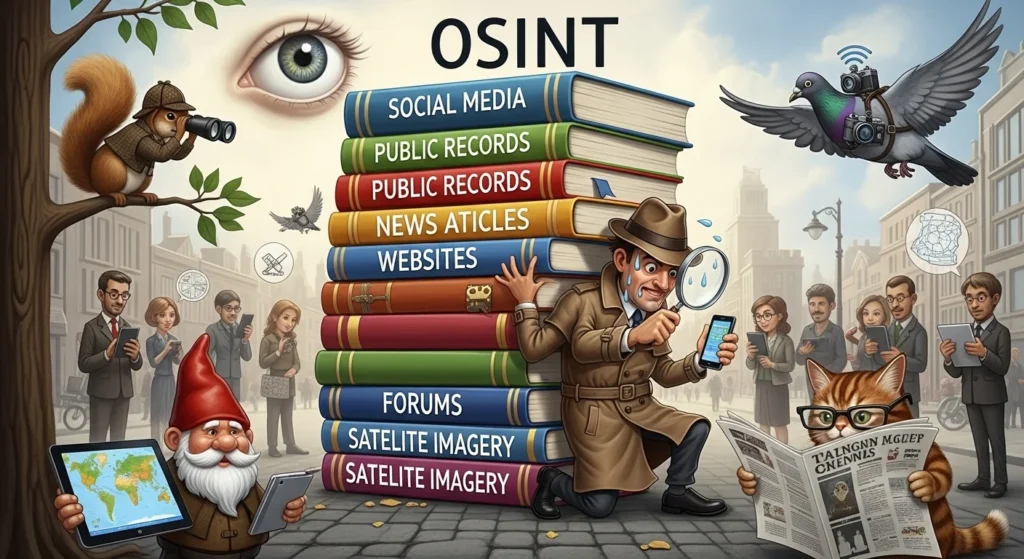

OSINT investigation
An OSINT investigation refers to the process of collecting and analyzing publicly available information to solve problems, find facts, or support research. OSINT stands for Open Source Intelligence, and it uses data from sources like websites, social media, news articles, forums, and public records.
Security analysts, journalists, and researchers use OSINT investigations to track cyber threats, verify identities, or uncover patterns in digital activity. Since it relies only on publicly accessible data, it does not involve hacking or illegal access.
In simple terms, OSINT investigation means gathering public information to understand people, events, or risks more clearly.
What is OSINT in cyber security
What is OSINT in cyber security refers to using open-source intelligence techniques to detect, analyze, and prevent cyber threats. Cybersecurity experts use publicly available data to identify vulnerabilities, monitor attackers, and strengthen digital defenses.
For example, security teams may analyze leaked data, domain information, or social media activity to detect potential risks before they become serious attacks. OSINT plays a key role in ethical hacking and threat intelligence.
In short, OSINT in cybersecurity means using public data to improve digital security and prevent cyber attacks.
OSINT Engineer
An OSINT Engineer is a professional who specializes in collecting, analyzing, and interpreting open-source data for security, intelligence, or research purposes. They use tools and techniques to gather information from online platforms, databases, and public records.
These engineers often work in cybersecurity, law enforcement, or private intelligence firms. Their role involves identifying threats, tracking digital footprints, and turning raw data into useful insights.
In simple terms, an OSINT Engineer is a specialist who finds and analyzes public information for security and investigation purposes.
Is OSINT legal
Is OSINT legal is a common question, and the answer is yes—OSINT is legal when it involves only publicly available information. Since it does not require hacking or accessing private data, it is widely used by professionals and organizations.
However, legality depends on how the information is collected and used. Misusing data, violating privacy laws, or engaging in harassment can make activities illegal even if the data is public.
In short, OSINT is legal when used ethically and within privacy laws.
OSINT pronunciation
OSINT pronunciation is typically said as “oh-sint” or “O-S-I-N-T” (spelling out the letters). Both versions are commonly used in cybersecurity and intelligence communities.
The simpler pronunciation “oh-sint” is more natural in conversation, while the letter-by-letter version is often used in formal or technical discussions.
In simple terms, OSINT is pronounced as “oh-sint.”
What is OSINT used for
What is OSINT used for refers to the many applications of open-source intelligence in real-world scenarios. It is used in cybersecurity, journalism, law enforcement, business research, and national security.
Professionals use OSINT to track cyber threats, verify information, investigate crimes, analyze competitors, and monitor online activity. It helps turn public data into actionable intelligence.
In short, OSINT is used for research, investigation, security, and decision-making.
Open source intelligence websites
Open source intelligence websites are online platforms that provide publicly available data for research and investigation. These include search engines, social media platforms, public records databases, and specialized OSINT tools.
Examples include Google, Shodan, Whois lookup tools, social media platforms, and public government databases. Analysts use these sites to gather information about domains, people, and digital activity.
In simple terms, OSINT websites are tools and platforms used to collect public information for analysis.
Open source intelligence examples
Open source intelligence examples show how publicly available data is used in real life. For instance, analyzing social media posts to track events, using domain lookup tools to identify website owners, or reviewing news reports for threat analysis.
Other examples include journalists verifying facts through public records or cybersecurity experts detecting leaked credentials online. These examples highlight how useful open data can be.
In short, OSINT examples include real-world uses of public information for investigation and analysis.
What Does “OSINT” Mean in Chat or Text?
OSINT stands for Open Source Intelligence. Essentially, it’s the practice of collecting and analyzing information that is publicly available—think social media posts, websites, news articles, forums, and more.
Key points about OSINT:
Primary meaning: Gathering information from publicly accessible sources.
Context-dependent: In casual chat, OSINT can also jokingly refer to “snooping online” or “researching someone’s digital footprint.”
Origin: The term comes from cybersecurity and intelligence communities, where professionals have used OSINT for decades to gather actionable insights without hacking or illegal activity.
Fun fact: While it’s a serious tool in professional settings, among teens and online communities, people might use OSINT humorously to describe stalking someone’s social media in a harmless way.
How People Use “OSINT” in Real Conversations
Platforms where OSINT appears:
Discord & Reddit: Users discuss hacking, gaming tips, or community research.
Twitter/X & Instagram: People refer to “doing OSINT” on public posts to find info.
Texting & DMs: Lighthearted use, like checking someone’s publicly available info before meeting them.
Professional chat apps (Slack, Teams): Used in a serious context for research and analysis.
When it’s appropriate vs awkward:
Appropriate: Talking about research, digital investigations, cybersecurity, or online fact-checking.
Awkward: Using it casually when someone might misinterpret it as spying or invading privacy.
Insider tip: Many Gen Z and millennial users joke about “OSINT skills” when someone does a deep dive into someone else’s online presence, even if it’s just social media browsing.
Real-Life Examples of “OSINT” in Text Messages
Here are some common examples and explanations:
Text Chat Example:
Friend 1: “Did you find her birthday?”
Friend 2: “Yeah, a little OSINT on her Instagram.”
Explanation: They used publicly available info to figure out the birthday.
Gaming Forum Example:
User A: “Anyone got the map locations?”
User B: “I did some OSINT; found all spawn points.”
Explanation: Researching available game info online.
Work Context Example:
Colleague: “We need intel on this competitor.”
You: “I’ll do some OSINT and see what I can gather.”
Explanation: Professional context of gathering public info.
Casual Humor Example:
Friend: “How do you know he likes jazz?”
You: “OSINT, my friend. Checked his playlist.”
Explanation: Playful use of OSINT as “snooping.”
Forum Example:
User: “Can anyone verify this news?”
Reply: “OSINT confirms it’s legit.”
Explanation: Using open-source research to fact-check information.
Common Mistakes & Misunderstandings
Confusing OSINT with hacking: OSINT is fully legal; it only uses publicly available data.
Using it in the wrong context: Saying “I’m doing OSINT” casually around people unfamiliar with the term can seem creepy.
Tone misinterpretation: In professional environments, it’s serious; in casual chats, it can be joking.
Pro tip: Always clarify your meaning if your audience isn’t familiar with cybersecurity terms.
Related Slangs & Abbreviations
Here are some chat terms often mentioned alongside OSINT:
FOIA: Freedom of Information Act—used to access public records.
LEINT: Law Enforcement Intelligence (formal counterpart to OSINT).
SOCMINT: Social Media Intelligence, a subset of OSINT.
Dox: Informal and often illegal research of someone’s private info online—different from OSINT, which is legal.
Intel: Short for intelligence, frequently used in professional and casual contexts.